- Executive summary
- Table of contents
- Introduction 300
- Methodology 400
- Policy alignment 500
- Cogan site context
- Problem statement
- Minimum Acceptable Levels of Access
- Objectives
- Impacts
- Appraisal against objectives
- Appraisal of impacts
- Summary recommendations
- Stage 2: shortlist options
- Delivery, financial and commercial case
- Stage 3: conclusion
Total: 4,800 words
Accessibility, sustainability and liveability: WelTAG report for Cogan Station area, Cardiff
Destination Cogan: a new placemaking paradigm
1. Executive summary
Across Cogan, Wales and the world, we all face a turbulent future. The more marginalised amongst us are already suffering the most. By focussing our efforts on improving resilient and adaptive transport network for those with the least, we improve transport for all.
“Everyone deserves safe, reliable, and affordable transportation options” (Davis, 2023, p. 32)
- We need to invest in connected public transport and active travel in the Cogan Station area, for an equitable response to the inevitable, uncertain and unfolding climate crisis.
- It is essential that properly funded community engagement that represents the diversity of Cogan is at the centre of mobility interventions: to improve outcomes for all, strengthen community relationships and to ensure that resources are allocated fairly.
- We should take advantage of the opportunities offered by the community engagement process to collaborate across governments and between departments, sharing the goals of accessibilty, sustainability and liveability between different teams on symbiotic and parallel projects.
- Harnessing all of the above, we can tap into the creative potential of the communities of Cogan to rejuvenate the place, transform it into a destination for others, and a safer, quieter and cleaner place for all those who live and work there.
Bella Akopian, Jake Rayson, John San Luis, Kim Hards Cardiff University, 14 January 2026
2. Table of contents
- Executive summary
- Table of contents
- Introduction
- Methodology
- Policy alignment
- Cogan site context
- Problem statement
- Minimum Acceptable Levels of Access
- Objectives
- Impacts
- Appraisal against objectives
- Appraisal of impacts
- Summary recommendations
- Stage 2: shortlist options
- Delivery, financial and commercial case
- Stage 3: conclusion
3. Introduction
We are on course for 4˚C average temperature rise by the end of the century (Collins et al 2013), with the intensification of extreme weather events — “sea levels could rise by over a metre by 2100, average summer temperatures may climb over 4°C, and extreme rainfall events might double in frequency by the 2050s” (NICW, 2025, p. 4).
This is the future for which we are designing our infrastructure, a future that calls for climate resilience and adaptation.
Fortunately, the climate crisis is an opportunity to enact all five well-being ways of working (collaboration, integration, involvement, long-term and prevention) (Welsh Govt., 2015, p. 8) in the co-definition of mobility issues and co-creation of possible solutions with the communities of the Cogan Station area, co-ordinated with cross-departmental co-operation.
At the heart of the project lies placemaking, where “the local community are involved in the development of proposals” (Welsh Govt., 2024, p. 15) which dramatically enhance the liveability of the Cogan area, so that it becomes a well-served and accessible destination in its own right, boosting the local economy, whilst simultaneously bringing “services to people in order to reduce the need to travel.” (Ibid. p. 3)
In a broad policy context, there is a need to reduce emissions whilst increasing accessibility and liveability. In practical terms, this means dramatically reducing car use whilst increasing walking, cycling and the use of public transport; all the while being mindful of access to safe, reliable and affordable transport for marginalised people.
Our initial overview of problems were the lack of step-free access and a clear interchange at the railway station, long bus wait times and dark, unsafe and unsheltered walking and wheeling journeys nearby, with a dearth of green infrastructure in some locations.
But it is important to remember that “Equity starts with an inclusive outreach process to understand what is the community’s need rather than what you may interpret as the need.” (Davis, 2023, p. 39). This outreach process should develop into a truly participatory and democratic placemaking venture. “Instead of viewing consulting with people and communities as a purely formal duty, authorities should co-design adaptation strategies with them.” (NICW, 2025, p. 5)
4. Methodology
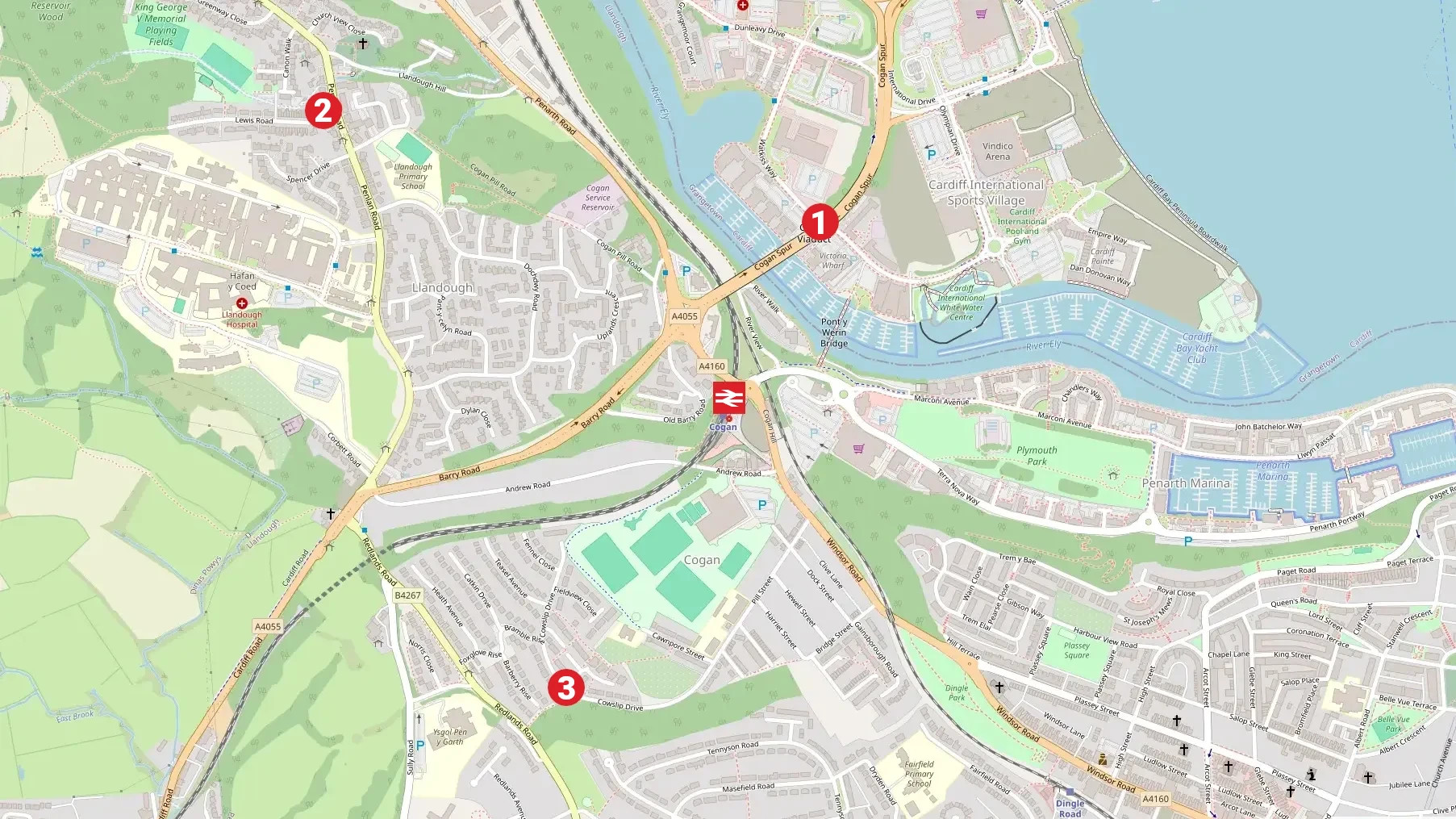 Cogan Station area, showing location of 3 personas
We have modelled the initial problem definitions and outline options using three personas:
- Ford Watkiss Way — young disabled man (wheelchair user), highest income quintile, car owner
- Lewis Road — elderly widowed woman (75),state retirement income, no access to a car
- Cowslip Drive — young single mother with two children, lowest income quintile, no access to a car
Whilst a useful starting point for thinking about different life situations and experiences when defining mobility problems for the area, for example, when creating accessibility calculations, what is essential is to have a diversity of real life people communicating their real life mobillity problems.
To that end, we propose a full community engagement process in co-defining problems and co-designing options. Infrastructure in a very real sense can be viewed as relationships. “What can be studied is always a relationship or an infinite regress of relationships. Never a “thing.” (Bateson, 1978, p. 249)”. Conversely relationships, encompassing social relationships in diverse communities, can be seen as infrastructure. And this social infrastructure provides a continual feedback loop that informs mobility work in progress, which is in itself an opportunity to gather data and fine-tune options.
“Infrastructure is both relational and ecological—it means different things to different groups and it is part of the balance of action, tools, and the built environment, inseparable from them.” (Star, 1999, p. 377)
Rather than being seen as a checkbox exercise to fulfil a bureaucratic requirement, community engagement needs to be front and centre of any transport planning, because climate adaptation is inherently a question of justice, and placemaking is inherently a locally bound cultural phenomenon. Once enabled by accessible processes, people from a diversity of backgrounds can engage in complex conversations about climate and infrastructure. “The co-design process proved essential to building trust and tailoring methods to local contexts.” (NICW, 2025, p. 26)
The other branch to our approach is the emphasis on government cross-departmental working. A great deal is invested in setting up the infrastructure of community engagement, and this is a waste of resources if the work is limited solely to a narrow definition of transport interventions. It is an ideal opportunity to improve communication between departments and collaborate with other projects in a joined up manner, such as housing, education, economic regeneration, biodiversity etc.
An example of such a collaboration would be with the Vale of Glamorgan Nature Partnership in the creation of a green roof roundwood bus waiting and wildlife watching room in the heart of a regenerated wildlife forest garden park.
5. Policy alignment
Committed and exploratory community engagement and cross-departmental working are by their very nature co-production approaches, in the service of well-being through addressing climate adaptation for shared infrastructure.
Our project aligns with much high level Welsh Government policy, from the foundational Future Generations Act, Planning Policy Wales, Active Travel Act and Llwybr Newydd (all encompassed by the Welsh Government Transport Appraisal Guideance, through to the consultative work of Net Zero Wales 2035 and the National Infrastructure Commission for Wales.
5.1 Well-being of Future Generations Act (2015)
“Wales faces a number of challenges now and in the future, such as climate change, poverty, health and wellbeing, coronavirus, jobs and economic activity. To tackle these we need to work together.” (Welsh Govt., 2015, p. 5)
The Future Generations Act is a foundational cornerstone of Welsh Government policy. This report embraces the Act wholeheartedly, with our emphasis on community engagement, inter-departmental working and sustainable transport options, encased in a co-production approach. “Taking a co-production approach addresses all five ways of working.” (Reynolds, 2025, p. 12)
- Our aim is to act in collaboration with Cogan‘s diverse communities as well as across departments in the Vale of Glamorgan Council, Cardiff Council and Welsh Government.
- We will consider how to integrate and balance the impact of our transport infrastructure options, which emphasise public transport and active travel, on well-being goals and other objectives.
- The importance of involving a diversity of people from the area interested in helping achieve our mobility well-being goals is central to our mission.
- It is important to balance the measures to address short-term inequality in the Cogan area with the measures required to address the long-term inequities of climate change.
- The prevention and amelioration of worsening conditions through equitable climate adaptation, namely through the provision of rugged, localised low-carbon options.
5.2 Planning Policy Wales
“Everyone engaged with or operating within the planning system in Wales must embrace the concept of placemaking in both plan making and development management decisions in order to achieve the creation of sustainable places and improve the well‐being of communities.” (Welsh Govt., 2024, p. 12)
5.3 Active Travel Act (Wales) 2013
“promote active travel journeys and secure new and improved active travel routes and related facilities” (Welsh Govt., 2021, p. 21)
5.4 Llwybr Newydd
“Firstly, we need to bring services to people in order to reduce the need to travel… Secondly, we need to allow people and goods to move easily from door-to-door by accessible, sustainable and efficient transport services and infrastructure… Thirdly, we need to encourage people to make the change to more sustainable transport” (Welsh Govt., 2021, p. 4)
5.5 Net Zero Wales 2035
“We advise adopting a transformative mobility agenda to avoid, shift and improve the movement of people and goods. This approach will reduce car dependency and accelerate progress towards net zero, whilst also improving health, wellbeing and enhancing social equity and inclusion.” (Wales Net Zero 2035, 2024, p. 4)
5.6 National Infrastructure Commission for Wales
“We recommend that early, inclusive public engagement become standard practice for all climate-related plans and projects and that dedicated teams and people are established to enact this.” (NICW, 2025, p. 5)
- future generations act
- aligns with all well-being goals
- planning policy wales
- llwybr newydd
- active travel
- the perfect storm
- net zero wales
options
- safe circular cycle route for children
- new cycle routes
- forest garden
- free transport for residents
- purchase field, construction cycle track, extension allotments into wildlife forest garden silvopasture,
allys
Fortunately, the climate polycrisis is an opportunity to flex
accessibility: for all ages & mobilities sustainability: net zero liveability: green infrastructure. economic resilience.
infrastructure as relations
Placemaking
over and again
welsh govt as audience - 5 sites, 2 councils, 3 wards no, Vale of Glamorgan, with emphasis on working with
1200 words
interventions - free public travel, cycle lanes, bus station
critique of brief
- Which area? Cogan is listed but actually Watkiss Way in Grangetown and Lewis Road in Llandough. Not clearly defined as community.
- No budget
- Use of personas - as guide. But need actual community engagement with actual people rather than fictional personas
- Identifying problems, again, without community engagement
- objectives and impact criteria -
profound shift
- free water
- resilient infrastructure is not profitable, “over-engineered”
- extreme weather - rainfall, temperatures, AMOC. south west water example
- “you don’t miss it until it’s gone”
- supply of food, water, fuel, materials, communications, labour. Extreme weather
- Need: economic security, food, healthcare
- Essential to look at societal level for provision of need, the markets aren’t delivering in terms of GHG reduction, pollution, species extinction “Need satisfiers 1st order (societal level)” (Mattioli, 2016, p. 6)
- Role of direct democracy (AKA community engagement) in determining need and allocating resources.
- universal basic services
- well-being, above all
- the vision: ambitious, joined up, cross-departmental programme.
- carbon reduction - housing, transport, food; in order of output Climate Watch (2025) – with major processing by Our World in Data
- physical and social infrastructure - infrastructure as relationships The Ethnograpy of Infrastructure
- Cogan as destination
- Destination for visitors
- Destination for residents
- Economic regeneration, critically, small, local business
- Place making, mark making, king making
- aim massive decarbonisation, 50% reduction
- MONITORING OF SCHEME for health outcomes
- Free public transport for all Cogan residents
- Participation - direct democracy in deciding allocation of economic resources
- Communities (plural) deciding on priorities, with help of planners
- quote from guideance ““Taking a co-production approach addresses all five ways of working. ” Well-being of Future Generations Act National Stakeholder Forum 2022 (Reynolds, 2025, p. 12)
- CARDIFF-WIDE CYCLE ROUTES
- Free school dinners
- Free public transport
- Free child care
- Palliative care
- Free bikes & bike repair & training
- With all the infrastructure this entails
- Co-define problems
- Big % budget on participation. Footbridge can cost £5m.
- Climate resilience and adaptation*
- Poverty
The children “spoke with candour about things that most people would consider basic, but which for them are out of their reach: a safe home that isn’t mouldy - or full of rats, a bed big enough to stretch out in, basic food like bacon, a place to do their homework, having the heating on, privacy in the bathroom and being able to wash, having their friends over, not having to travel hours to school, or having a local park to play safely in where the grass isn’t overgrown and unusable.” (Souza, 2025, p. 3)
Poverty is a failure of society, of political, economic and social processes. We have a duty as citizens and decision makers to change these processes. This is the framework
Placemaking is an “approach to development which ensures communities have all the services they need within easy reach and development is of high quality.” (Welsh Govt., 2025, p. 75)
none of this makes any difference unless you solve the underlying systemic economic problem of capitalism, which is the abstraction of value at an industrial scale
- Young Disabled Man = Fford Watkiss Way (first one we went to)
- Elderly Woman = Lewis Road
- Single Mother = Cowslip Road
weltag - well-being llwybr newydd future generations act
democracy, justice, equality - all in the service of well-being
County lines - River Ely, so this is cross-authority project by definition
- Cardiff Council - Grangetown ward
So, Cogan, Llandough / Llandochau Fach, Grangetown - covered
Cardiff LDP just submitted
Climate change injustice disproportionately effects individuals in developing nations, economically disadvantaged individuals and communities, indigenous populations, women and individuals with health vulnerabilities
(Greer 2023)
Provision of:
- School meals
- Breakfast clubs
- Uniforms
- Child care
- Travel
Situates transport planning as integral part of progressive policy making to increase justice
Time poverty
A vision to transform well-being for the people of Cogan
Climate crisis, of which Covid pandemic a part, opportunity to establish models if best practise for climate resilience and adaptation.
Has o be part of wider, coordinated strategy of social provision of essentials
Necessity of community engagement, not just consultation, in ongoing process of I transport improvement
Leveraging regional funds, providing blueprint for action
FGA - working across departments, guidance. Transport does not operate in isolation
Housing + providing homes, not investment vehicles. Use what we have more wisely
Provision of local srvixes - GPs, hospice, old People’s home, food, pub, cafe
Aim to drastically improve well-being of the people and ecology of Cogan (culture) so that becomes destination, local hub and dramatically reduces car use. A model project.
Use funding for innovative relatinlons, processes and technology
Planning is formed and informed through a process of continuing engagement (guidance, emergent)
Name the departments for collaboration
Cardiff wide network of foot and cycle paths
Cogan as destination, for visitors and residents
Part of broader collaborative strategy for decarbonisation, democratisation, climate resilience and adaptation which relies on democratisation, education and collaboration
Where policy meets reality Grounded in place
The Wales Net Zero 2035 Challenge Group was commissioned by the leaders of the Welsh Government and Plaid Cymru through the 2021 Cooperation Agreement and published reports aimed to accelerate Wales’s approach to achieving net zero.
The Cogan
Cogan planning for extreme weather & social instability Planning for The Climate Crisis
Radical manifesto for degrowth at the local level
Jake Bibliography
- Collins, M., R. Knutti, J. Arblaster, J.-L. Dufresne, T. Fichefet, P. Friedlingstein, X. Gao, W.J. Gutowski, T. Johns, G. Krinner, M. Shongwe, C. Tebaldi, A.J. Weaver and M. Wehner, 2013: Long-term Climate Change: Projections, Commitments and Irreversibility. In: Climate Change 2013: The Physical Science Basis. Contribution of Working Group I to the Fifth Assessment Report of the Intergovernmental Panel on Climate Change [Stocker, T.F., D. Qin, G.-K. Plattner, M. Tignor, S.K. Allen, J. Boschung, A. Nauels, Y. Xia, V. Bex and P.M. Midgley (eds.)]. Cambridge University Press, Cambridge, United Kingdom and New York, NY, USA
- Davis, V.O. 2023. Inclusive transportation: a manifesto for repairing divided communities. Washington, DC: Island Press.
- Ditlevsen, P. and Ditlevsen, S. 2023. Warning of a forthcoming collapse of the Atlantic meridional overturning circulation. Nature Communications 14(1), p. 4254. Available at: www.nature.com/articles/s41467-023-39810-w .
- Foxman, D. and Bateson, G. 1973. Steps to an Ecology of Mind. The Western Political Quarterly 26(2), p. 345. Available at: www.jstor.org/stable/446833?origin=crossref
- NICW 2025. A Perfect Storm: Is Wales doing enough to coordinate action and engage communities in adapting our infrastructure to a changing climate? National Infrastructure Commission Wales.
- Reynolds, D. 2025. Building culture for co-production : A manual for applying the Wellbeing of Future Generations Act. Available at: www.gov.wales/building-culture-for-co-production-html.
- Star, S.L. 1999. The Ethnography of Infrastructure. American Behavioural Scientist.
- Welsh Govt. 2015. Well-being of Future Generations Act : the essentials. Available at: www.gov.wales/well-being-future-generations-act-essentials-html.
- Welsh Govt. 2024. Planning Policy Wales. 12th edn. Available at: www.gov.wales/planning-policy-wales.
- Welsh Govt. 2021. Llwybr Newydd : The Wales Transport Strategy 2021.
- Wales Net Zero 2035. 2024. How could people and places be connected by 2035. Available at: netzero2035.wales/our-reports/how-could-people-and-places-be-connected-by-2035/.